
The Top Five Reasons Why Engineers Should Learn Simulation: Accelerate Innovation, Reduce Costs, and Design with Confidence
Engineering Has Changed—Has Your Design Process?
In today’s competitive manufacturing environment, engineers are expected to design smarter products faster than ever before. Whether developing industrial machinery, automotive components, aerospace assemblies, medical devices, consumer electronics, or heavy equipment, the pressure to shorten development cycles while maintaining exceptional quality continues to grow.
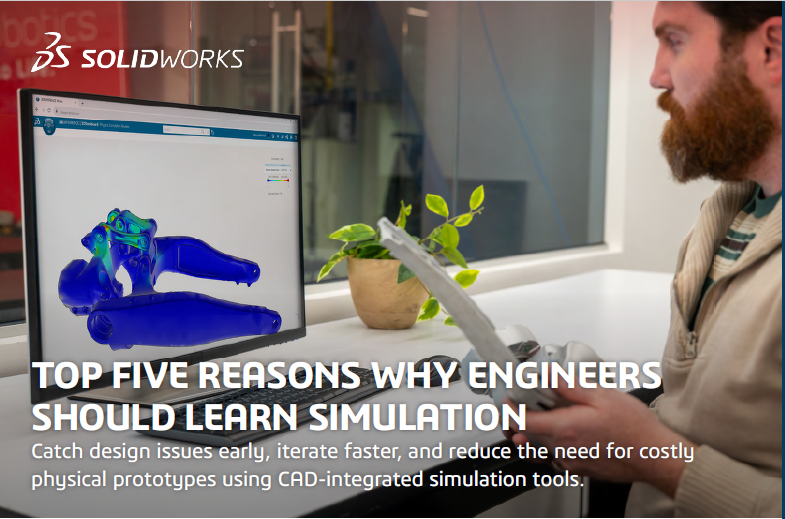
top five reasons why engineers should learn solidworks simulation
Traditional product development often depended on building multiple physical prototypes, testing them, identifying failures, redesigning, and repeating the cycle. Although effective, this approach is expensive, time-consuming, and limits innovation.
Engineering simulation has transformed this process.
By integrating simulation directly into the product development workflow, engineers can evaluate structural strength, thermal performance, fluid flow, vibration, fatigue, and manufacturability before producing a single physical prototype. Instead of relying on assumptions, engineering teams make informed decisions using real performance data.
Simulation-driven design is no longer reserved for specialized analysts. With modern solutions like SOLIDWORKS Simulation, simulation has become an everyday engineering tool that enables designers and engineers to optimize products earlier, reduce development costs, and bring innovations to market faster.
What Is Engineering Simulation?
Engineering simulation is the process of digitally evaluating how a product will perform under real-world operating conditions using advanced mathematical and physics-based models.
Instead of physically testing every design iteration, engineers can simulate product behavior in a virtual environment to predict:
- Structural strength
- Stress distribution
- Deflection
- Heat transfer
- Airflow
- Fluid movement
- Fatigue life
- Vibration
- Motion
- Manufacturing feasibility
Simulation technologies commonly include:
- Finite Element Analysis (FEA)
- Computational Fluid Dynamics (CFD)
- Thermal Analysis
- Motion Simulation
- Fatigue Analysis
- Injection Molding Simulation
- Electromagnetic Simulation
- Multiphysics Simulation
This virtual approach significantly reduces uncertainty while increasing engineering confidence.
Why Simulation Matters More Than Ever
Manufacturers today face numerous challenges:
- Increasing product complexity
- Shorter product development cycles
- Higher customer expectations
- Rising material costs
- Sustainability requirements
- Global competition
- Pressure to innovate continuously
Every design decision affects manufacturing costs, product reliability, customer satisfaction, and long-term profitability.
Without simulation, engineers often discover problems only after manufacturing prototypes, leading to expensive redesigns and delayed product launches.
Simulation changes this completely.
By validating performance digitally, organizations can identify weaknesses during design rather than after production, resulting in faster innovation and fewer costly surprises. This proactive engineering approach is one of the biggest shifts in modern product development.
Reason 1: Simulation Builds Confidence Through Reliable Engineering Results
One of the first questions engineers ask when beginning simulation is:
“Can I trust the results?”
The answer depends not on the software alone but on how accurately the simulation reflects real-world conditions.
Modern simulation software is built on proven engineering principles that have been validated across industries for decades. When engineers define accurate material properties, realistic loads, appropriate constraints, and quality meshes, simulation produces highly reliable insights that support sound engineering decisions.
How Simulation Creates Reliable Results
Accurate simulation depends on four key foundations:
1. High-Quality CAD Geometry
Clean CAD models eliminate gaps, overlaps, and unnecessary complexity that could negatively affect simulation accuracy.
2. Accurate Material Properties
Selecting the correct material ensures realistic predictions of stress, deformation, thermal behavior, and fatigue performance.
3. Proper Mesh Generation
The mesh divides the model into small computational elements. A well-refined mesh improves analysis accuracy while maintaining computational efficiency.
4. Realistic Boundary Conditions
Simulation must accurately represent real operating conditions, including:
- Applied forces
- Fixtures
- Contacts
- Pressure
- Temperature
- Motion
Together, these inputs produce trustworthy engineering data that engineers can confidently use for design decisions.
From Guesswork to Data-Driven Engineering
Traditional engineering often relied on conservative assumptions.
Engineers intentionally overdesigned products to reduce failure risk.
While safe, this approach frequently resulted in:
- Higher material costs
- Increased product weight
- More expensive manufacturing
- Reduced efficiency
Simulation replaces guesswork with measurable engineering data.
Instead of asking,
“I think this will work.”
Engineers can confidently state,
“Simulation confirms this design meets performance requirements.”
Benefits of Trustworthy Simulation
Organizations implementing simulation typically achieve:
- Reduced engineering uncertainty
- Better product reliability
- Lower redesign costs
- Improved customer satisfaction
- Increased engineering confidence
- Optimized material usage
- Faster decision-making
Simulation doesn’t replace engineering expertise—it enhances it.
Real-World Example: Accelerating Product Innovation with Virtual Prototyping
One example highlighted in the source material demonstrates how simulation helped engineers refine thermal performance, optimize mechanical systems, and reduce dependence on repeated physical prototypes, enabling faster product development and improved collaboration across engineering disciplines.
This illustrates how virtual prototyping enables teams to:
- Evaluate multiple design alternatives
- Improve thermal efficiency
- Optimize moving components
- Reduce prototype costs
- Accelerate product launches
Reason 2: Simulation Solves Real Engineering Problems Before They Become Expensive
Every engineering project raises critical questions that influence product success.
Examples include:
- Will the structure withstand operational loads?
- Will electronic components overheat?
- Is airflow sufficient?
- Can the product survive years of continuous operation?
- Can the part be manufactured consistently?
Without simulation, answering these questions often requires expensive physical testing.
Simulation enables engineers to answer them digitally—early in the design process.
Structural Analysis
Structural simulation predicts how components respond to external loads.
It identifies:
- Maximum stress
- Deflection
- Safety factors
- Weak regions
- Potential failure locations
Rather than overdesigning products, engineers optimize strength while minimizing weight.
Industries benefiting include:
- Automotive
- Aerospace
- Heavy Machinery
- Industrial Equipment
- Consumer Products
- Medical Devices
Thermal Analysis
Modern products generate heat.
Excessive temperatures can reduce reliability, shorten product life, and increase warranty costs.
Thermal simulation helps engineers evaluate:
- Heat transfer
- Cooling efficiency
- Temperature distribution
- Thermal expansion
- Heat sink performance
Applications include:
- Electronics
- Electric Vehicles
- Industrial Automation
- Battery Systems
- Medical Equipment
By identifying thermal hotspots early, engineers improve product reliability before manufacturing begins.
Computational Fluid Dynamics (CFD)
Many products depend on efficient airflow or liquid flow.
CFD simulation helps engineers visualize:
- Airflow paths
- Pressure distribution
- Fluid velocity
- Cooling performance
- Pump efficiency
- Valve performance
- Aerodynamic drag
Instead of relying solely on physical wind tunnel or flow testing, engineers optimize fluid behavior virtually, reducing development time and improving performance.
Fatigue and Durability Analysis
A product that performs well on its first day may still fail after months or years of repeated use.
Fatigue simulation predicts:
- Product lifespan
- Crack initiation
- Cyclic stress behavior
- Long-term durability
- High-risk failure locations
This enables organizations to reduce warranty claims while increasing customer confidence.
Multiphysics Simulation
Real-world engineering problems rarely involve only one physical phenomenon.
Heat affects structural strength.
Airflow influences temperature.
Thermal expansion changes stress distribution.
Fluid pressure impacts structural deformation.
Multiphysics simulation combines multiple analyses to provide a more realistic representation of actual operating conditions, enabling engineers to design safer and more efficient products.
Reason 3: Address Problems Earlier in the Design Process
One of the biggest advantages of engineering simulation is its ability to identify design issues before they become expensive manufacturing problems. The earlier a design flaw is detected, the easier and less costly it is to correct. Simulation enables engineers to evaluate multiple design concepts digitally during the concept stage, helping them make informed decisions before investing in tooling or prototypes.
The Cost of Late Design Changes
A simple engineering change during the concept phase may take only a few hours. The same modification after tooling has been manufactured can cost thousands—or even millions—of rupees and significantly delay product launches.
Late-stage design changes often lead to:
- Increased engineering hours
- New tooling costs
- Production delays
- Material waste
- Higher manufacturing expenses
- Missed market opportunities
Simulation minimizes these risks by validating product performance before production begins.
Simulation During the Concept Phase
Rather than asking:
“Will this finished design work?”
Engineers can ask:
- Which concept is lighter?
- Which design is stronger?
- Which geometry offers better airflow?
- Which material performs best?
- Which design provides the longest fatigue life?
This digital experimentation encourages innovation because engineers can compare multiple alternatives without the expense of building physical prototypes.
Benefits of Early Simulation
- Better design decisions
- More design iterations
- Faster optimization
- Reduced engineering risk
- Lower development costs
- Higher product quality
Design Validation
Simulation also plays an important role in validating final designs before manufacturing.
At this stage engineers verify:
- Structural integrity
- Safety margins
- Thermal performance
- Product reliability
- Manufacturing feasibility
Although validation remains valuable, organizations achieve the greatest return on investment when simulation begins much earlier in product development rather than only at the end.
Reduce Overdesign
Many engineers naturally add extra material “just to be safe.”
While this conservative approach reduces failure risk, it often creates:
- Heavier products
- Higher raw material costs
- Increased machining time
- Greater transportation costs
Simulation identifies exactly where strength is required, enabling engineers to remove unnecessary material while maintaining safety factors.
The result is:
- Lightweight designs
- Lower manufacturing costs
- Improved sustainability
- Better product performance
Customer Success Story: CALOI
A leading bicycle manufacturer transformed its product development process by integrating simulation with its CAD workflow. According to the case study, the company reduced development cycles from approximately two months to two weeks, shortened time to market, cut prototyping costs by around 50%, and significantly reduced design errors and rework through simulation-led validation before physical testing.
This demonstrates that simulation is not only a design tool—it is also a business strategy that improves productivity and profitability.
Reason 4: Streamline Engineering Workflows
Engineering teams today need more than accurate designs—they need seamless collaboration.
Historically, design and analysis were separate processes.
A designer completed the CAD model.
Then the file was transferred to a simulation specialist.
After analysis, results returned to the designer for modifications.
This cycle often repeated several times.
The result?
- Longer development cycles
- Communication delays
- Version control problems
- Reduced productivity
Modern CAD-integrated simulation eliminates these barriers.
Integrated Design and Simulation
With SOLIDWORKS Simulation, engineers can:
Design → Simulate → Optimize → Validate
all within the same software environment.
Instead of switching between multiple applications, engineers immediately evaluate design performance while modeling.
Benefits include:
- Faster iterations
- Improved collaboration
- Reduced errors
- Better productivity
- Consistent design data
Shared Digital Models
Today’s engineering projects involve:
- Mechanical Engineers
- Manufacturing Engineers
- Electrical Engineers
- Project Managers
- Quality Teams
- Suppliers
Cloud-connected engineering platforms ensure every stakeholder works from the latest design.
This improves:
- Communication
- Traceability
- Design approval
- Project management
- Cross-functional collaboration
A single source of truth helps teams make decisions faster with greater confidence.
High-Performance Computing (HPC)
Large simulation studies can require significant computational power.
Cloud-based High-Performance Computing (HPC) enables engineers to:
- Solve larger models
- Run multiple simulations simultaneously
- Reduce processing times
- Free local workstation resources
Instead of waiting days for complex analyses, engineers can complete simulations much faster and continue developing products without interruption.
Continuous Design Improvement
Every simulation produces valuable engineering insights.
These insights feed directly into the next design iteration.
This continuous improvement cycle enables organizations to:
- Optimize products faster
- Reduce prototype quantities
- Improve product reliability
- Increase engineering productivity
Simulation becomes an everyday engineering activity rather than a separate department.
Customer Success Story: Inovonics
A wireless communications manufacturer adopted electromagnetic simulation to predict antenna performance before building hardware. By simulating different installation environments and electromagnetic behavior, the engineering team anticipated issues early, reduced design revisions, achieved successful proof-of-concept prototypes, and improved collaboration using cloud-connected workflows.
Reason 5: Shape the Future of Engineering
Engineering is rapidly evolving.
Artificial Intelligence.
Cloud Computing.
Digital Twins.
Automation.
High-Performance Computing.
These technologies are changing how products are designed.
Simulation sits at the center of this transformation.
Artificial Intelligence
AI is making simulation more accessible than ever.
Future simulation software will automatically:
- Create meshes
- Suggest materials
- Define boundary conditions
- Recommend design improvements
- Optimize geometry
- Predict failures
Instead of spending hours preparing models, engineers will spend more time interpreting results and innovating.
Cloud-Based Simulation
Cloud computing removes hardware limitations.
Benefits include:
- Anywhere access
- Faster simulations
- Lower IT costs
- Secure collaboration
- Scalable computing resources
Small and medium-sized businesses can now access advanced engineering capabilities without investing in expensive computing infrastructure.
Digital Twins
Simulation is evolving beyond product development.
Digital Twins combine:
- CAD
- Simulation
- IoT Sensors
- Real-time operational data
This enables manufacturers to monitor product performance throughout its lifecycle.
Benefits include:
- Predictive maintenance
- Performance optimization
- Reduced downtime
- Improved customer satisfaction
Sustainable Engineering
Simulation contributes directly to sustainability.
By optimizing products digitally, organizations reduce:
- Material waste
- Energy consumption
- Prototype production
- Manufacturing scrap
- Carbon emissions
Simulation supports environmentally responsible product development while lowering operating costs.
Customer Success Story: RangeAero
An autonomous aircraft developer used advanced simulation integrated with its design workflow to model complex nonlinear behavior, automate simulation tasks, and optimize rotorcraft designs. The reported results included shorter design cycles, reduced prototyping and development costs, and significantly faster time to market.
Industries That Benefit from Engineering Simulation
Simulation has become an essential capability across numerous industries, including:
- Automotive
- Aerospace & Defense
- Industrial Machinery
- Consumer Products
- Medical Devices
- Electronics
- Renewable Energy
- Heavy Equipment
- Oil & Gas
- Robotics & Automation
- Packaging Machinery
- Plastic Injection Molding
- Sheet Metal Fabrication
Organizations across these sectors use simulation to improve performance, reduce costs, and accelerate innovation.
Why Choose SOLIDWORKS Simulation?
SOLIDWORKS Simulation integrates directly into the SOLIDWORKS CAD environment, enabling engineers to evaluate product performance without disrupting their design workflow.
Key capabilities include:
- Linear Static Analysis
- Nonlinear Analysis
- Fatigue Analysis
- Frequency Analysis
- Buckling Analysis
- Thermal Analysis
- Motion Simulation
- Drop Test
- Pressure Vessel Analysis
- Topology Optimization
- Flow Simulation
- Design Optimization
Whether you’re designing a simple bracket or a complex industrial assembly, SOLIDWORKS Simulation helps you validate and optimize designs efficiently.
Frequently Asked Questions.
What is engineering simulation?
Engineering simulation is the virtual testing of product performance using physics-based mathematical models before manufacturing.
Why should engineers learn simulation?
Simulation helps engineers reduce development costs, improve product quality, accelerate innovation, and make better engineering decisions based on data.
Can simulation replace physical prototypes?
No. Simulation complements physical testing by identifying issues earlier, reducing the number of physical prototypes needed, and improving confidence before final validation.
What industries use simulation?
Automotive, aerospace, industrial equipment, consumer products, electronics, medical devices, energy, and manufacturing industries all benefit from engineering simulation.
Is SOLIDWORKS Simulation suitable for beginners?
Yes. SOLIDWORKS Simulation integrates directly with SOLIDWORKS CAD, making it accessible for design engineers while also offering advanced capabilities for experienced analysts.
How does simulation reduce costs?
Simulation minimizes physical prototyping, reduces redesigns, shortens development cycles, optimizes material usage, and helps prevent costly manufacturing issues.
Final Thoughts
Engineering simulation is no longer a specialized capability reserved for analysts. It has become an essential skill for modern product development, empowering engineers to design with confidence, reduce development costs, and accelerate innovation.
Organizations that embrace simulation early gain a competitive advantage through better product quality, faster time-to-market, and more efficient engineering workflows. As AI, cloud computing, and automation continue to evolve, simulation will play an even greater role in shaping the future of engineering. The principles and real-world examples discussed throughout this article show how simulation enables teams to move from reactive problem-solving to proactive, data-driven design.
About SOPAN Infotech Pvt. Ltd.
We empower manufacturers, product designers, and engineering organizations with industry-leading CAD, CAM, CAE, and digital engineering solutions, including:
Whether you’re looking to validate designs, optimize product performance, or adopt simulation-driven engineering, our experts can help you implement the right solution for your business.
Book a Free Demo & Consultation
📞 +91 9727910606 | 🌐 www.sopaninfotech.com
| 📧 marketing@sopaninfotech.com

top five reasons why engineers should learn