
PoligonSoft Metal Casting Simulation Software: Complete Guide for Foundries and Manufacturers
Introduction
Metal casting is a complex manufacturing process in which geometry, material properties, temperature, molten-metal flow, solidification and cooling interact with one another.
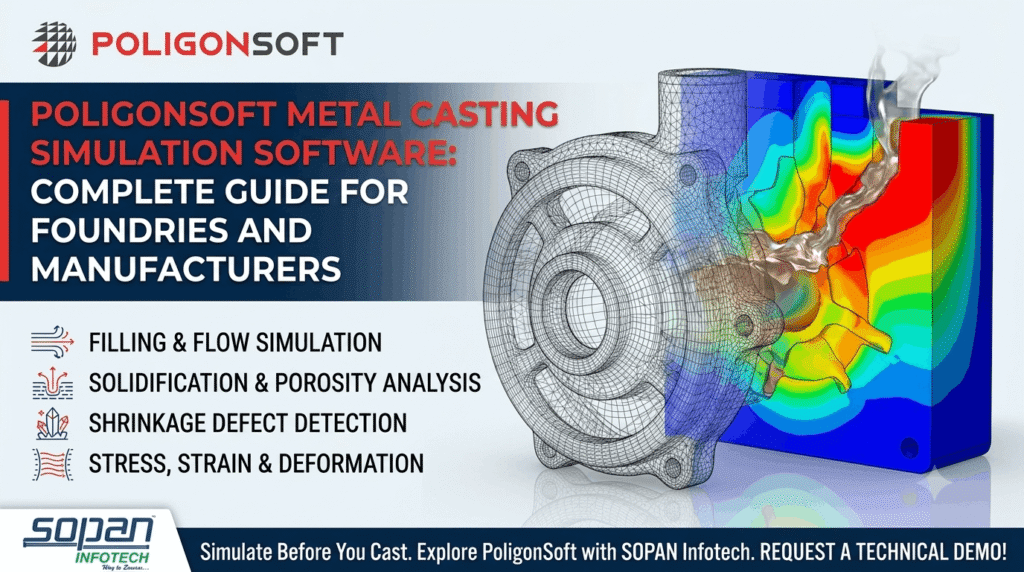
PoligonSoft by SOPAN Infotech — Advanced Casting Simulation Solutions for Modern Foundries & Manufacturers.
For foundries and casting manufacturers, identifying a potential problem only after a physical casting has been produced can lead to additional trials, tooling modifications, process changes and inspection cycles.
Metal casting simulation provides an additional engineering layer by allowing selected casting phenomena to be investigated virtually before or alongside physical validation.
SOPAN Infotech is introducing PoligonSoft, a metal casting simulation solution, into its engineering software portfolio to help organizations explore casting behaviour through numerical simulation.
Depending on the selected software configuration, PoligonSoft provides capabilities related to filling, solidification, shrinkage, porosity, stress, strain and deformation, together with mesh generation, material databases and results visualization.
The objective is not to replace foundry experience or physical testing.
Rather:
Engineering Experience + Simulation + Physical Validation = Better-Informed Casting Development
What Is PoligonSoft?
PoligonSoft is a metal casting simulation platform designed to digitally investigate casting processes and related thermal and mechanical phenomena.
Instead of examining only the final casting, engineers can investigate what may happen during the manufacturing process.
Typical engineering questions include:
- How does molten metal fill the mold?
- Where does the metal flow?
- How does temperature change during filling?
- Where are potential hot spots?
- How does solidification progress?
- Where could shrinkage occur?
- Where could macro- or microporosity develop?
- Could cooling contribute to stress or deformation?
- How might a design or process modification influence the result?
These questions can be relevant to foundries, casting engineers, production engineers, CAE professionals, quality teams and R&D departments.
Why Is Casting Simulation Important?
Casting involves several interconnected physical phenomena:
Geometry → Material → Temperature → Flow → Heat Transfer → Solidification → Cooling → Mechanical Behaviour
A change in one part of the process can influence another.
For example, filling behaviour can influence temperature distribution. Temperature distribution affects solidification. Solidification behaviour can influence feeding, shrinkage and porosity.
Simulation provides engineers with an opportunity to investigate these relationships before relying exclusively on physical trials.
Major PoligonSoft Simulation Capabilities
The exact capabilities depend on the selected PoligonSoft configuration and modules.
1. Filling and Flow Simulation
Filling simulation can help engineers investigate the movement of molten metal through the mold.
Potential areas of analysis include:
- Filling progression
- Metal velocity
- Temperature
- Pressure
- Flow behaviour
- Free-surface evolution
- Onset of solidification during filling
The commercial Euler functionality is intended for flow and filling analysis.
2. Solidification Simulation
Solidification is one of the most important stages of casting.
During cooling, different sections of a component may solidify at different rates.
Simulation can help engineers investigate:
- Temperature fields
- Phase fields
- Cooling behaviour
- Solidification progression
- Solidification time
- Hot spots
- Shrinkage-related behaviour
The Fourier solver is associated with thermal, solidification and porosity-related calculations.
3. Shrinkage and Porosity Analysis
As molten metal cools and solidifies, volumetric changes can occur.
Where feeding is insufficient, shrinkage-related cavities and porosity may develop.
Depending on the applicable configuration, PoligonSoft can help investigate:
- Shrinkage cavities
- Macro-porosity
- Micro-porosity
- Potential defect regions
- Hot-spot-related defect patterns
This can provide engineers with another source of information when investigating casting quality.
4. Stress, Strain and Deformation
Casting does not necessarily cool uniformly.
Thermal gradients and mechanical constraints can contribute to stress and deformation.
Applicable PoligonSoft functionality can be used to investigate:
- Stress
- Strain
- Residual stress
- Deformation
- Thermal/mechanical effects
The Hooke solver addresses stress and strain-related analysis.
5. Mesh Generation
Simulation requires a computational representation of the casting geometry.
PoligonSoft includes mesh-generation functionality to prepare models for analysis.
The mesh is an important part of simulation because model size, element distribution and geometry complexity can influence calculation requirements.
PoligonSoft and Casting Processes
Casting simulation requirements vary according to the manufacturing process.
The PoligonSoft information provided for this launch identifies applications including:
- Sand casting
- Investment casting
- Die casting
- Lost-foam casting
- Vacuum casting
- Chill casting
- Centrifugal casting
- Continuous casting
The exact functionality available depends on the selected modules and software configuration.
PoligonSoft Solvers and Digital Engineering
PoligonSoft follows a modular approach in which different solvers address different engineering phenomena.
The described solver architecture includes:
Euler : Flow and filling analysis.
Fourier : Thermal, solidification and porosity-related calculations.
Hooke : Stress and strain analysis.
Additional specialized capabilities cover areas such as heat treatment and macrostructure analysis.
This modular approach allows organizations to evaluate simulation capabilities according to their actual engineering requirements.
How Casting Simulation Fits Into the Engineering Workflow
A typical simulation-supported workflow can be structured as:
Step 1 — CAD Model : Prepare the casting geometry.
Step 2 — Mesh : Create the computational model.
Step 3 — Material : Define the relevant alloy and material properties.
Step 4 — Process Setup : Configure applicable casting conditions.
Step 5 — Simulation : Run the selected solver.
Step 6 — Results : Visualize temperature, flow, phase, porosity, stress or other applicable results.
Step 7 — Engineering Interpretation : Identify potential problem areas.
Step 8 — Design or Process Evaluation : Consider possible modifications.
Step 9 — Re-Simulation : Compare alternative approaches where appropriate.
Step 10 — Physical Validation : Validate the selected approach through appropriate physical testing.
Who Can Benefit From PoligonSoft?
Foundries
Investigate casting behaviour and potential defect regions.
Casting Engineers
Study filling, solidification, shrinkage and porosity.
CAE Engineers
Perform numerical casting analysis.
Production Engineers
Use simulation as an additional input for process-development decisions.
Quality Teams
Investigate potential relationships between process conditions and observed defects.
R&D Teams
Evaluate alternative casting approaches digitally.
PoligonSoft for Indian Manufacturing
India has a large casting and engineering ecosystem covering industries such as:
- Automotive
- Auto components
- Pumps
- Valves
- Industrial machinery
- Heavy engineering
- General engineering
- Aerospace
- Defence
- Precision manufacturing
Gujarat is particularly relevant for engineering, foundry and component-manufacturing applications.
SOPAN Infotech can support organizations evaluating PoligonSoft as part of their engineering software and simulation requirements.
Simulation Does Not Replace Engineering
An important principle should be maintained when implementing any casting simulation solution.
Simulation results depend on factors such as:
- Geometry
- Material data
- Mesh
- Boundary conditions
- Process parameters
- Physical assumptions
- Accuracy of input information
Therefore, simulation should not be treated as an absolute guarantee of production results.
The strongest approach remains:
Simulation + Engineering Knowledge + Physical Validation
Frequently Asked Questions
What is metal casting simulation?
Metal casting simulation is a computer-based engineering method used to investigate selected physical phenomena occurring during casting, including filling, thermal behaviour, solidification, shrinkage, porosity and mechanical effects.
What is PoligonSoft?
PoligonSoft is a metal casting simulation platform with dedicated solvers and modules for areas including flow/filling, thermal/solidification/porosity and stress/strain analysis.
Can PoligonSoft analyze porosity?
Yes. The applicable solidification/porosity functionality includes macro- and microporosity analysis and shrinkage-related investigation.
Can PoligonSoft identify hot spots?
Yes. Hot-spot identification is part of the described solidification and porosity capabilities.
Can PoligonSoft analyze stress and deformation?
Applicable commercial stress functionality can investigate stress, strain and deformation-related phenomena.
Which industries can use casting simulation?
Foundries and manufacturers working with automotive, pumps, valves, industrial machinery, engineering components and other cast products can evaluate whether casting simulation fits their engineering workflow.
Conclusion
Metal casting simulation is becoming an important component of digital engineering because it gives engineers an additional way to investigate casting behaviour before or alongside physical validation.
PoligonSoft provides a modular approach to casting simulation covering areas such as filling, solidification, shrinkage, porosity, stress and deformation depending on the selected configuration.
For organizations looking to introduce casting simulation into their engineering workflow, the first step should be to identify the actual manufacturing problem and then map that problem to the appropriate simulation capability.
Simulate Before You Cast. Make More Informed Engineering Decisions.
Ready to Explore Casting Simulation?
Your casting challenge deserves an engineering approach.
Discuss your component, material, casting process or defect with SOPAN Infotech and explore how PoligonSoft can fit into your workflow.
 Request a Technical Demo | Explore PoligonSoft FREE | Talk to Our Technical Team
Metal Casting Simulation for Smarter Engineering Decisions
For assistance :  +91 9727910606 |
  info@sopaninfotech.com |
  www.sopaninfotech.com