
Casting Defects, Porosity and Solidification: How Simulation Helps Foundry Engineers
Introduction
Casting defects are among the most important challenges faced by foundries and casting manufacturers.
A defect identified during final inspection may require additional investigation, process modification, rework or another physical production trial.
However, many casting defects are influenced by events that occur much earlier in the process.
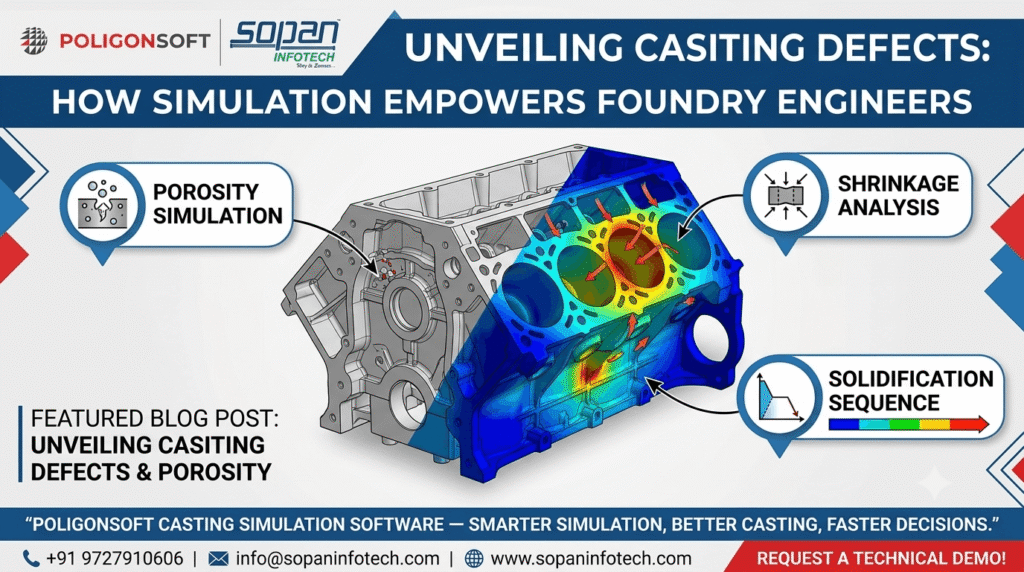
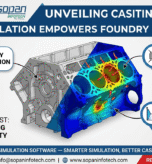
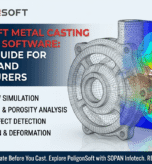
PoligonSoft by SOPAN Infotech — Advanced Casting Simulation Solutions for Modern Foundries & Manufacturers. (1)
The interaction between:
Geometry + Material + Filling + Temperature + Heat Transfer + Solidification + Cooling
can influence the final casting.
This is where casting simulation can provide additional engineering insight.
PoligonSoft provides applicable simulation capabilities for investigating phenomena such as:
- Filling
- Solidification
- Hot spots
- Shrinkage
- Macro-porosity
- Micro-porosity
- Stress
- Deformation
The exact capabilities depend on the selected modules.
What Are Casting Defects?
Casting defects are unwanted conditions that can occur during or after the casting process.
They can be associated with:
- Mold filling
- Solidification
- Feeding
- Cooling
- Gas behaviour
- Thermal gradients
- Geometry
- Material characteristics
- Process parameters
Understanding the possible relationship between these factors can be an important part of defect investigation.
1. Shrinkage Defects
Metal generally undergoes volumetric changes as it cools and solidifies.
If feeding conditions are insufficient, shrinkage-related cavities can develop.
The location and severity of shrinkage can be influenced by:
- Geometry
- Wall thickness
- Thermal gradients
- Solidification sequence
- Feeding conditions
- Local hot spots
Simulation can help engineers visualize the solidification process and investigate potential shrinkage regions.
2. Porosity
Porosity represents void-related defects within a casting.
Depending on the mechanism and applicable simulation approach, engineers may investigate:
- Macro-porosity
- Micro-porosity
- Shrinkage cavities
Porosity can be particularly important in components where mechanical performance, pressure integrity or structural quality matters.
PoligonSoft’s applicable solidification and porosity capabilities provide tools for investigating these potential defect patterns.
3. Hot Spots
A hot spot is an area that remains hot and solidifies later than surrounding regions.
Hot spots can be important because they may indicate areas requiring further investigation of feeding and solidification behaviour.
Engineers can investigate hot spots in relation to:
- Feeder/riser placement
- Local geometry
- Thermal gradients
- Cooling conditions
- Insulation
- Feeding behaviour
Simulation can provide a visual representation of these areas and help engineers determine where further engineering attention may be appropriate.
4. Filling Problems
Filling is another important stage of casting.
During mold filling, engineers may need to understand:
- Flow progression
- Metal velocity
- Temperature
- Pressure
- Free-surface behaviour
- Onset of solidification
If molten metal loses sufficient temperature or the flow conditions are unsuitable, some regions may not fill as intended.
The commercial Euler functionality in PoligonSoft is designed for flow and filling analysis.
Understanding Solidification Through Simulation
Solidification behaviour has a direct relationship with several casting-quality considerations.
As different regions cool at different rates, engineers can investigate:
Temperature Field → Phase Field → Solidification Sequence → Hot Spots → Shrinkage/Porosity
The PoligonSoft Fourier solver is associated with thermal, solidification and porosity-related calculations.
This makes thermal and solidification analysis an important part of a broader casting-defect investigation workflow.
From Defect to Engineering Investigation
A useful way to think about simulation is:
Physical Casting
↓
Defect Identified
↓
Potential Process Causes
↓
Simulation
↓
Result Analysis
↓
Engineering Decision
↓
Physical Validation
Simulation does not automatically identify a single guaranteed cause.
Instead, it provides additional information that qualified engineers can use alongside physical evidence and manufacturing experience.
How PoligonSoft Can Support Defect Investigation
A typical workflow can include:
Step 1 — Prepare Geometry
Import or prepare the casting model.
Step 2 — Generate Mesh
Create the computational representation.
Step 3 — Define Material
Select the applicable material information.
Step 4 — Define Process
Enter relevant process conditions.
Step 5 — Select Solver
Choose the appropriate simulation capability.
Step 6 — Run Simulation
Calculate the selected physical phenomena.
Step 7 — Analyze Results
Review temperature, phase, flow, hot spots, shrinkage, porosity or other applicable results.
Step 8 — Investigate
Compare simulation observations with actual casting behaviour.
Step 9 — Evaluate Changes
Consider possible design or process modifications.
Step 10 — Validate
Perform appropriate physical validation.
Can Simulation Eliminate Casting Defects?
No—not by itself.
Simulation is an engineering decision-support technology.
Actual casting results can depend on:
- Material properties
- Process control
- Mold conditions
- Machine parameters
- Geometry
- Operator practices
- Environmental conditions
- Quality of input data
- Accuracy of simulation assumptions
Therefore, simulation results should be interpreted appropriately and validated where required.
Casting Simulation vs Trial-and-Error
A traditional development cycle may look like:
Design → Tooling → Physical Trial → Inspection → Defect → Modification → New Trial
A simulation-supported workflow can introduce a virtual investigation stage:
Design → Simulation → Result Analysis → Modification → Re-Simulation → Physical Trial → Validation
The purpose is not to eliminate physical trials.
The purpose is to make engineering decisions before physical validation more informed where simulation is appropriate.
Where Simulation Can Add Value
Product Development
Investigate potential thermal and solidification concerns during development.
Feeding Studies
Investigate hot spots, shrinkage and potential porosity.
Defect Investigation
Compare simulated results with observed casting defects.
Process Development
Evaluate potential process scenarios before physical trials.
Engineering Communication
Use visual simulation results to communicate complex physical behaviour.
Simulation and Industry 4.0
Casting simulation can also form part of a broader digital manufacturing workflow.
A digital foundry engineering process can connect:
CAD → Simulation → Engineering Decision → Manufacturing → Inspection → Validation
This creates an opportunity to combine:
Experience + Data + Simulation + Physical Validation
Rather than replacing traditional foundry knowledge, digital simulation can complement it.
Frequently Asked Questions
What casting defects can simulation investigate?
Depending on the selected solver and configuration, simulation can investigate filling behaviour, solidification, hot spots, shrinkage cavities, macro- and microporosity and stress/deformation-related phenomena.
Can PoligonSoft predict porosity?
The applicable PoligonSoft solidification and porosity functionality provides macro- and microporosity analysis and shrinkage-related investigation.
Can PoligonSoft identify hot spots?
Yes. Hot-spot identification is included within the described solidification and porosity capabilities.
Can simulation replace physical casting trials?
No. Simulation should complement engineering knowledge and physical validation rather than replace them.
Why is solidification important in casting simulation?
Solidification influences thermal behaviour, hot spots, feeding, shrinkage and porosity. Understanding the solidification sequence can therefore support defect investigation.
Conclusion
Casting defects are often the result of interconnected thermal, material, geometric and process conditions.
Casting simulation provides engineers with an additional way to investigate these relationships before or alongside physical validation.
With applicable PoligonSoft modules, engineers can investigate filling, solidification, hot spots, shrinkage, porosity, stress and deformation as part of an integrated casting-analysis workflow.
Ready to Explore Casting Simulation?
Your casting challenge deserves an engineering approach.
Discuss your component, material, casting process or defect with SOPAN Infotech and explore how PoligonSoft can fit into your workflow.
👉 Request a Technical Demo | Explore PoligonSoft FREE | Talk to Our Technical Team
Metal Casting Simulation for Smarter Engineering Decisions
For assistance : 📞 +91 9727910606 | 📧 info@sopaninfotech.com | 🌐 www.sopaninfotech.com